
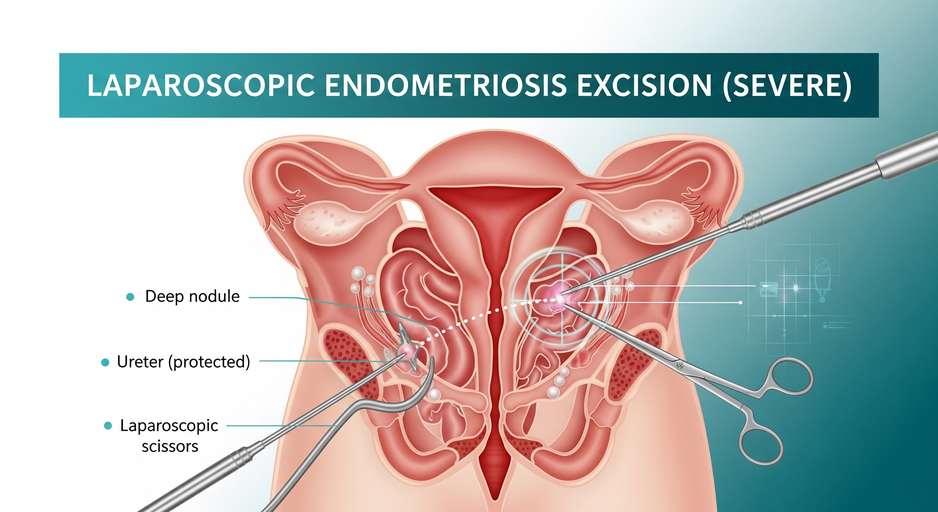
Severe Endometriosis: Laparoscopic/Endoscopic Specialist Excision
Leveraging China's top gynecological endoscopy team and ultra-minimally invasive surgical techniques, we offer a deep and thorough lesion excision solution for severe endometriosis patients, greatly alleviating pain, protecting fertility function, and restoring a healthy life.
Included Services
Not Included
Suitable Conditions
Deep Infiltrating Endometriosis
Severe Dysmenorrhea
Infertility
Our Service Process
Making your medical journey affordable and hassle-free

Comprehensive Preoperative Assessment
Detailed inquiry of medical history, gynecological examination, combined with pelvic ultrasound, MRI, and other imaging studies to accurately assess endometriosis staging, classification, and infiltration depth.

Multidisciplinary Team Consultation (MDT)
For complex cases, initiate MDT discussion to jointly develop an individualized surgical plan and contingency plan.

Preoperative Preparation
If necessary, conduct colonoscopy, urinary tract imaging, and other examinations, and perform bowel preparation.

Undergoing Laparoscopic Surgery
Performed under general anesthesia. Establish pneumoperitoneum, insert laparoscope, explore pelvic and abdominal cavity, precisely excise all visible lesions, separate adhesions, and restore anatomy.

Postoperative Recovery
Encourage early mobilization after surgery, with a hospital stay of approximately 3-5 days.
Long-term Management and Follow-up
Endometriosis is a chronic condition, requiring long-term medication management (such as GnRH-a, dienogest) post-surgery as per medical advice to prevent recurrence, with regular follow-ups.
Ready to review this treatment plan?
Send your medical records and travel needs. We will help match hospitals and coordinate the next steps in China.
Key Benefits
Ultimate Clearance, Reduced Recurrence
Adhering to the 'what is visible can be removed' philosophy, using ultra-high-definition laparoscopy/robotic technology, we strive to completely excise deep infiltrating endometriosis (DIE) lesions, reducing recurrence rates.
Ultimate Precision, Preserve Function
Surgery as delicate as embroidery, thoroughly excising lesions while maximizing the preservation of uterine, ovarian, intestinal, and urinary system functions, with a special focus on preserving fertility.
Multidisciplinary Team (MDT) Support
For complex endometriosis involving the intestines and urinary system, gynecology, general surgery, and urology experts perform surgery together to ensure safety and thoroughness.
Minimally Invasive Surgery, Rapid Recovery
Compared to traditional open surgery, laparoscopic surgery causes less trauma, less pain, shorter hospital stays, and faster postoperative recovery, allowing a quicker return to normal life.
Why is laparoscopic/endoscopic surgery needed?
Medication can control symptoms but cannot cure, and symptoms easily recur after stopping medication. For severe endometriosis, laparoscopic surgery is the 'gold standard' for diagnosis and treatment.
What is Severe Endometriosis?
Endometriosis is a disease caused by endometrial tissue growing outside the uterine cavity. Severe endometriosis usually refers to deep infiltrating endometriosis (DIE), where lesions infiltrate to a depth of ≥5mm, potentially affecting the sacral ligaments, rectum, bladder, ureters, causing severe dysmenorrhea, chronic pelvic pain, dyspareunia, infertility, and bowel and urinary symptoms, greatly impacting quality of life and mental health.
This disease greatly affects quality of life and mental and physical health.
Why Choose Us
Technical and Equipment Advantages
Equipped with top-tier equipment such as 3D/4K ultra-high-definition laparoscopes, fluorescence imaging, and robotic surgery systems, assisting surgeons in achieving precise navigation and excision in complex anatomical areas, maximizing the protection of vital organs.
Expert Team Advantage
Led by senior experts from the Endometriosis Group of the Chinese Medical Association's Obstetrics and Gynecology Branch, completing hundreds of complex endometriosis laparoscopic surgeries annually, with extensive experience in the diagnosis and treatment of DIE.
Multidisciplinary Team (MDT) Advantage
Established a mature Gynecology-General Surgery-Urology MDT team to provide one-stop surgical solutions for complex patients involving the intestines and urinary tract, avoiding the pain of multiple surgeries.
Accessibility and Cost-Effectiveness Advantage
Technology synchronized with top international centers, but costs significantly lower than in Europe and America.
Frequently Asked Questions
Can surgery cure endometriosis completely? Will it recur?
Endometriosis, due to its 'infiltration and metastasis' characteristics similar to malignant tumors, cannot currently be guaranteed to be cured, and there is a possibility of recurrence. The recurrence rate is closely related to the severity of the disease, the thoroughness of the surgery, and whether postoperative management is standardized. Our goal is to maximize the delay of recurrence through extremely meticulous complete excision surgery and standardized long-term medication management, allowing patients to achieve a long-term, symptom-free, high-quality life.
Will the surgery affect my fertility?
Our surgical principle is 'fertility preservation first.' For patients with fertility needs, the surgery will be extremely meticulous to avoid damaging normal ovarian tissue and the uterus. The surgery itself, by removing lesions and improving the pelvic environment, is beneficial for pregnancy. For patients who still require assisted reproductive technology post-surgery, we will closely collaborate with reproductive specialists to choose the optimal timing.
How is surgery performed if the lesions invade the intestines or bladder?
This is precisely where our multidisciplinary team (MDT) adds value. Superficial lesions: lesion excision ('shaving'). Deep infiltrating lesions: if only part of the intestinal wall muscle layer is invaded, a disc excision (removal of the lesion, suturing of the intestinal wall defect) can be performed; if the entire intestinal wall layer or a large area is invaded, a general surgeon is needed to perform a bowel segment resection and anastomosis. The same applies to bladder lesions. The MDT team ensures the safety and thoroughness of such complex surgeries.
Ready to review this treatment plan?
Send your medical records and travel needs. We will help match hospitals and coordinate the next steps in China.