
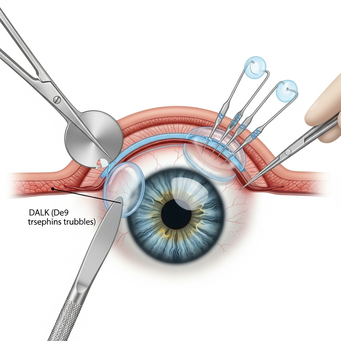
Deep Anterior Lamellar Keratoplasty (DALK)
Deep anterior lamellar keratoplasty (DALK) may be considered when keratoconus causes significant scarring, risk of perforation, or inability to obtain functional vision with lenses, and endothelial function is good. The decision is based on corneal thickness/scar depth, infection control, previous surgical history, donor tissue availability, and overall health status, and is determined by a comprehensive specialist assessment.
Included Services
Not Included
Stay Required
Usually hospitalized for 3–5 days, depending on incision healing, corneal status, and pain control.
It is recommended to stay nearby for about 7–14 days after discharge to complete follow-up visits, medication adjustments, and suture observation.
Including pre-operative assessment and early follow-up, it is generally recommended to stay for 2–4 weeks; subject to the actual schedule of the hospital.
Our Service Process
Making your medical journey affordable and hassle-free

Choose the Right Treatment, Surgeon & Hospital
We help you find the right medical solution for your needs

Arrange Video/Telephonic Consultation
Connect with expert doctors remotely to understand your treatment

Assist with Visa & Accommodation
We handle travel arrangements and hospital timing for your peace of mind

Airport Pickup and Hospital Transfer
Coordinate arrival support, local transfer, and interpreter scheduling

Hospital Assistance & Post-Op Support
Full medical coordination and caring assistance during recovery
Ready to discuss this treatment plan?
Send your medical records and travel needs. We will help match hospitals and coordinate the next steps in China.
What is Deep Anterior Lamellar Keratoplasty (DALK)?
Deep anterior lamellar keratoplasty replaces the damaged anterior stroma while preserving the recipient's Descemet's membrane and endothelium. A common practice is to inject gas into the corneal stroma to form a separation, or to gradually cut and remove the diseased tissue in layers, and then suture and fix the donor anterior stroma with the endothelium removed. Postoperatively, corneal transparency, corneal shape, and intraocular pressure are monitored, with the goal of improving optical quality and reducing endothelial-related risks. The above is general health information and not medical advice; specific information is subject to specialist assessment and hospital protocols. Deep anterior lamellar keratoplasty (DALK) may be considered when keratoconus causes significant scarring, risk of perforation, or inability to obtain functional vision with lenses, and endothelial function is good. The decision is based on corneal thickness/scar depth, infection control, previous surgical history, donor tissue availability, and overall health status, and is determined by a comprehensive specialist assessment.
Preparation Before Treatment
In addition to a comprehensive ophthalmological examination and corneal topography/pachymetry/tomography, assess scar depth and endothelial function; complete routine blood and infection screening, anesthesia assessment, and review drug allergies and anticoagulant medications; stop wearing contact lenses as directed and avoid ocular surface inflammation; informed consent and donor tissue instructions; prepare translation and itinerary. All arrangements are subject to consultation at the medical institution.
How is Deep Anterior Lamellar Keratoplasty (DALK) performed?
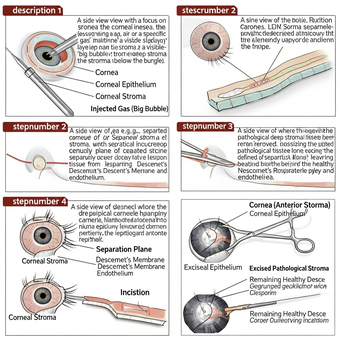
Deep anterior lamellar keratoplasty replaces the damaged anterior stroma while preserving the recipient's Descemet's membrane and endothelium. A common practice is to inject gas into the corneal stroma to form a separation, or to gradually cut and remove the diseased tissue in layers, and then suture and fix the donor anterior stroma with the endothelium removed. Postoperatively, corneal transparency, corneal shape, and intraocular pressure are monitored, with the goal of improving optical quality and reducing endothelial-related risks. The above is general health information and not medical advice; specific information is subject to specialist assessment and hospital protocols.
Inject gas into the corneal stroma to form a separation.
无
Gradually cut and remove the diseased tissue in layers.
无
Suture and fix the donor anterior stroma with the endothelium removed.
缝合
Postoperatively, monitor corneal transparency and intraocular pressure.
无
Recovery Process
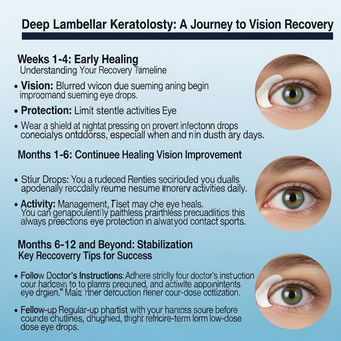
Postoperative visual recovery is staged, and regular eye drops and scheduled follow-up visits are required in the early stage; avoid rubbing the eyes and collisions, and postpone water activities such as washing the face and swimming. The suture retention time and removal strategy are determined by follow-up, and may require multiple adjustments. Whether or not to fly is subject to the doctor's assessment, and please bring medical records and a list of medications when going out. Seek medical attention promptly if symptoms worsen or vision changes suddenly.
Administer eye drops regularly and follow-up visits as scheduled.
Avoid rubbing the eyes and collisions, and postpone washing the face and swimming.
The suture retention time is determined by follow-up.
Treatment Options
The path can be weighed between deep anterior lamellar keratoplasty (DALK) and penetrating keratoplasty (PKP); DALK can choose "big bubble" or layered cutting, and can be converted to full-thickness transplantation if necessary. Corneal cross-linking or contact lens correction can also be considered in early cases; whether to combine cataract and other surgeries is comprehensively assessed by a specialist team, and no uniform conclusion is made.
Cost Notes
Commonly includes: pre-operative assessment (visual acuity, slit lamp, corneal topography/pachymetry/OCT if necessary/related assessment), donor tissue acquisition and eye bank screening fees, operating room and microscopic equipment, anesthesia and routine consumables, basic care and postoperative medications during hospitalization, discharge summary and routine follow-up visits. Not included: additional treatment for complications, upgrades to special consumables, exceeding standard hospitalization days and travel expenses, etc., subject to the hospital quotation.
Donor tissue acquisition and eye bank fees, surgical technique path (big bubble/layered cutting), anesthesia method, sutures and consumables, imaging and laboratory tests, level and length of hospitalization, complication management, and reoperation, etc. The above information is general health information and not medical advice; diagnosis and treatment and costs are subject to consultation assessment and official notification from the hospital.
Cost reference updated: 2025-08
Frequently Asked Questions
Will rejection occur?
DALK preserves the endothelium, and the immune-related risks and manifestations are different from full-thickness transplantation; seek medical attention as soon as possible if redness, pain, or vision loss occurs.
What if DALK is not suitable?
Penetrating transplantation may be performed, or contact lenses, cross-linking, and other protocols may be used, and the final path is subject to specialist assessment.
Will the surgery leave scars?
The corneal incision needs to be sutured, and fine suture marks may remain on the surface; the optical quality depends on healing and suture adjustment.
Can I pass security or have an MRI?
Sutures and transplanted tissue generally do not affect security checks or MRI; it is recommended to bring surgical records and a doctor's certificate when going out.
Where does the donor cornea come from?
Usually donated corneas are provided by compliant eye banks and meet screening and quality standards; acquisition and use are subject to local laws and procedures.
Can I wear contact lenses after surgery?
It depends on the assessment of corneal shape and suture stability, and some people can wear rigid or scleral lenses to optimize vision.
Do I need to take medication for a long time?
Antibiotic and steroid eye drops are commonly used in the early stage, and then gradually reduced; the course and frequency are adjusted by the doctor during follow-up.
How long will it take to return to work/study?
The recovery progress varies greatly, and near vision and driving need to be confirmed by follow-up; it is recommended to reserve sufficient rest time.
Ready to discuss this treatment plan?
Send your medical records and travel needs. We will help match hospitals and coordinate the next steps in China.